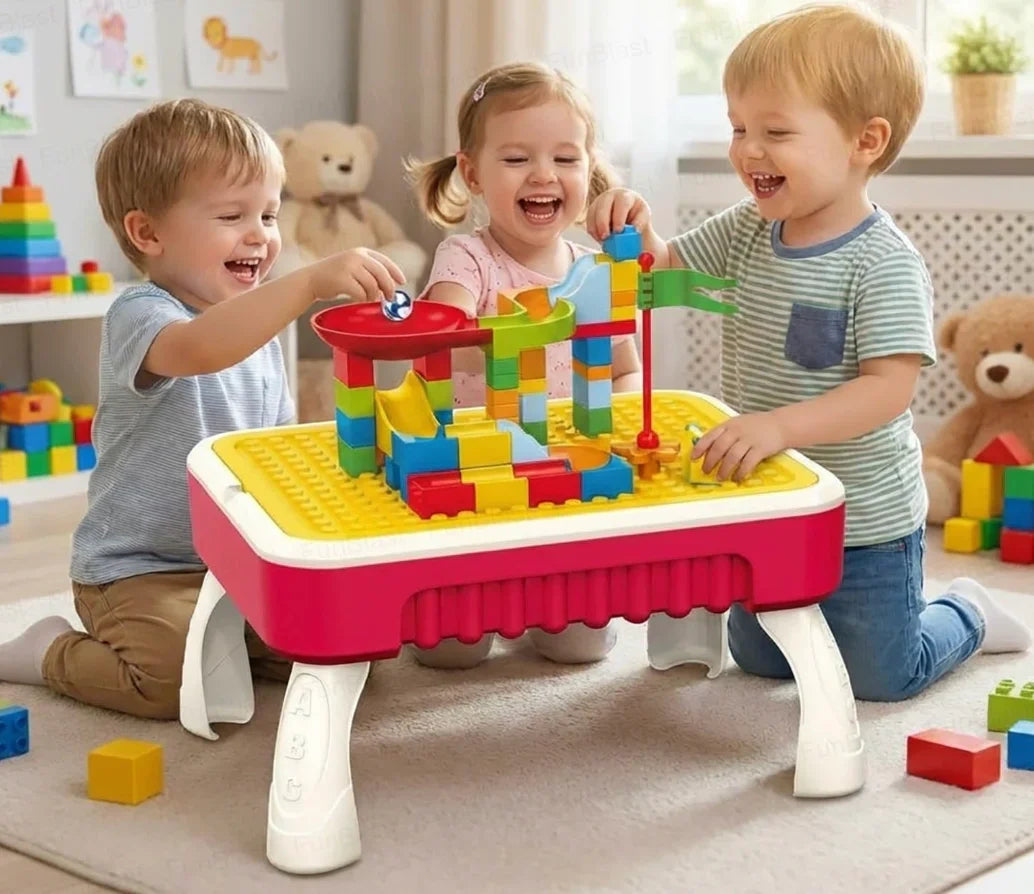
A cupboard full of toys and a toddler who still reaches for your phone is a familiar problem for Pakistani parents. The gap is rarely a lack of toys; it's a lack of the right toy for the child's exact stage. Buy a toy too advanced and it sits untouched; buy one too simple and it's ignored within a week. This guide breaks Montessori toys down by age, 0 to 6, so you match toy to stage instead of guessing.
What Actually Makes a Toy "Montessori"
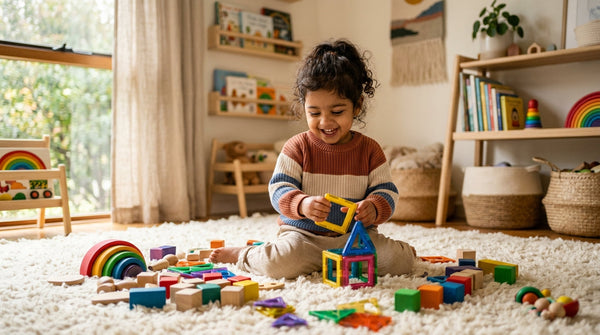
A Montessori toy isolates one skill at a time — sorting, stacking, threading — instead of doing five things with lights and sound. It's usually made from wood or another natural material, has one clear right way to use it, and lets the child see their own mistake and correct it without being told. This "control of error" is what separates a real Montessori toy from a battery-powered toy wearing the label as a marketing term.
0-12 Months: Sensory Toys, Not Screens
At this age, a baby is learning to track objects, grasp with purpose, and connect cause with effect, since a rattle shakes because they shook it. The World Health Organization's 2019 guidelines on physical activity and screen time are direct on this age group: screen time is not recommended at all for children under 1. So the toy has to do the entertaining, not a tablet.
High-contrast textures, simple sound-makers, and toys that respond instantly to a small hand's movement work best here. In our own 0-1 Year collection, the Wooden Geometric Shape Sorter is a good example: one shape fits one hole, the baby sees the mismatch instantly, and there's no electronic feedback substituting for the child's own discovery.
Pulling live prices from our own catalog for this age band: the seven products we currently stock for 0-1 year olds range from roughly Rs. 899 to Rs. 2,699, with sensory and sound toys at the lower end and multi-piece activity books at the higher end.
1-3 Years: Independence and Fine Motor Control
This is where Montessori toys earn their reputation. A 1-2 year old is building the hand strength and coordination for everything that follows, from holding a spoon to eventually holding a pencil. Wooden stacking rings, simple puzzles with knobbed pieces, and busy boards with real zips and latches all target this directly.
Our Busy Montessori Kit Sensory Book is built for exactly this stage: each page isolates one fastener — a button, a buckle, a lace — so the child masters one skill before turning the page to the next. This is the same "one concept at a time" principle behind classic Montessori materials, just adapted into a portable book format that ships well within Pakistan.
By 2-3 years, WHO's guidance allows up to one hour of sedentary screen time a day for this age band, but frames less as better. A Montessori toy that holds a toddler's attention for that same hour, a full activity book, say, or a stacking tower rebuilt six times, does the same job a screen would, without the screen.
Live pricing across our 1-3 Years collection: ten products range from Rs. 799 to Rs. 3,199, with wooden puzzles at the affordable end and multi-activity sensory books at the top.
3-5 Years: Letters, Numbers, and Early Logic
A preschooler's hands are steady enough for real pincer-grip work — threading, writing motions, sorting by more than one attribute at once. This is the age where alphabet and number materials start to matter, since the child is building pre-reading and pre-math skills whether or not they're in formal school yet.
The Rainbow Wooden Stacker Toy still has a place here for color and size sequencing, but this age also benefits from magnetic building sets and number puzzles that ask the child to plan a few steps ahead, not just match one piece to one slot. Our 3-5 Years collection prices ten products between Rs. 699 and Rs. 4,730; the wider range reflects a mix of simple wooden puzzles and larger construction and drawing sets that hold attention longer at this age.
5-8 Years: Bridging to School-Ready Play
By 5, a child can handle toys with more open-ended structure — building sets with a design goal, early science kits, logic games with real rules instead of just sorting. This is a transition stage more than a hard cutoff, so it's worth browsing our 5-8 Years collection alongside the 3-5 range rather than switching over on a birthday.
The Montessori principle doesn't disappear at school age either; it just shifts from sensory isolation to structured problem-solving. A magnetic building set or a real working microscope kit follows the same "concrete before abstract" logic as a toddler's shape sorter, just at a harder level.
Montessori Toys by Age: Quick Reference
| Age Band | What to Look For | Typical Price Range (Live Catalog) |
|---|---|---|
| 0-12 months | High-contrast, sound/texture response, no small parts | Rs. 899 - Rs. 2,699 |
| 1-3 years | Stacking, sorting, busy boards with real fasteners | Rs. 799 - Rs. 3,199 |
| 3-5 years | Letters, numbers, multi-step building | Rs. 699 - Rs. 4,730 |
| 5-8 years | Open-ended building, early logic and science | Rs. 2,499 - Rs. 6,899 |
Why the Age Label on a Toy Actually Matters
The age recommendation on a toy isn't a marketing suggestion: it's tied to a physical safety test. Under the EU's toy safety framework, any toy meant for a child under 36 months cannot contain a part small enough to fit inside a standardized test cylinder roughly the size of a three-year-old's throat; if it does, the toy has to carry a small-parts choking warning and isn't meant for that age group at all (European Commission, Toy Safety Directive 2009/48/EC). That's the real reason a busy board built for a 3-year-old often isn't right for a 10-month-old, even if both are "Montessori" — it's a safety threshold, not just a difficulty one.
When you're choosing between a solid wooden toy and something with smaller detachable pieces, check the stated age range against your child's real stage, not just their birthday — a large, advanced 3-year-old and a cautious 3-year-old don't always want the same toy.
FAQs
Is it worth buying different Montessori toys for every age, or can one toy last longer? A few toys genuinely stretch across ages: stacking rings and wooden blocks get used differently at 1 and at 4. But a toy chosen for its "control of error" at one stage often becomes too easy within 6-8 months, so budgeting for a new piece every few months serves the child better than one expensive toy meant to last years.
Are wooden Montessori toys safer than plastic ones for toddlers? Safety depends on construction, not material alone: a wooden toy with a poorly finished edge is not automatically safer than a well-made plastic one. What matters is checking for smooth edges, secure paint, and no detachable small parts for children under 3, per the standards above.
What's the single best Montessori toy for a 1-year-old in Pakistan? For most 1-year-olds, a simple shape sorter or stacking toy works better than anything electronic, since it directly builds the grasp-and-release coordination this age is developing. Our own wooden shape sorter, covered in the 0-12 months section above, is priced at the affordable end of that category.
Do Montessori toys actually reduce screen time, or is that just marketing? A toy competes with a screen only if it holds attention the same way, and WHO's own screen-time guidance for under-5s assumes something else is filling that time. A busy board or activity book that takes 20-30 minutes of focused, hands-on work genuinely displaces that much screen time, which is the logic behind our screen-free toddler activities post.
How do I know if a toy is too advanced for my child's age? If the child needs constant help to use it or loses interest within a minute, the toy is likely a stage ahead of them. A well-matched Montessori toy should let the child struggle briefly, then succeed on their own — that's the signal to look for, not just the age number printed on the box.
Browse the full range by age in our Educational Toys collection, or start with the age band your child is in right now rather than trying to future-proof the whole cupboard at once.